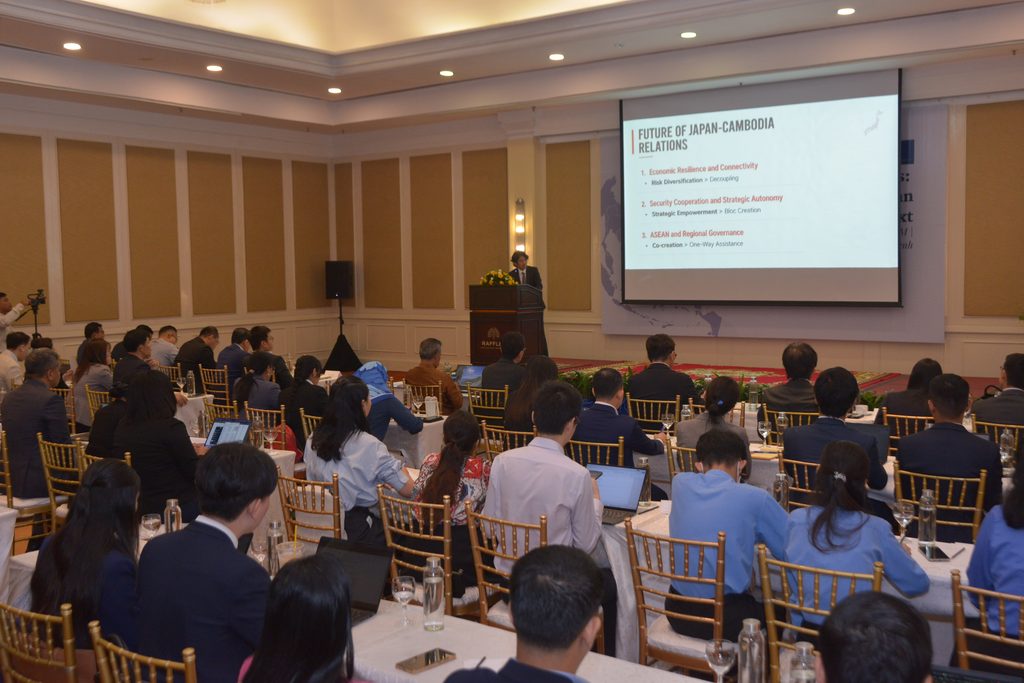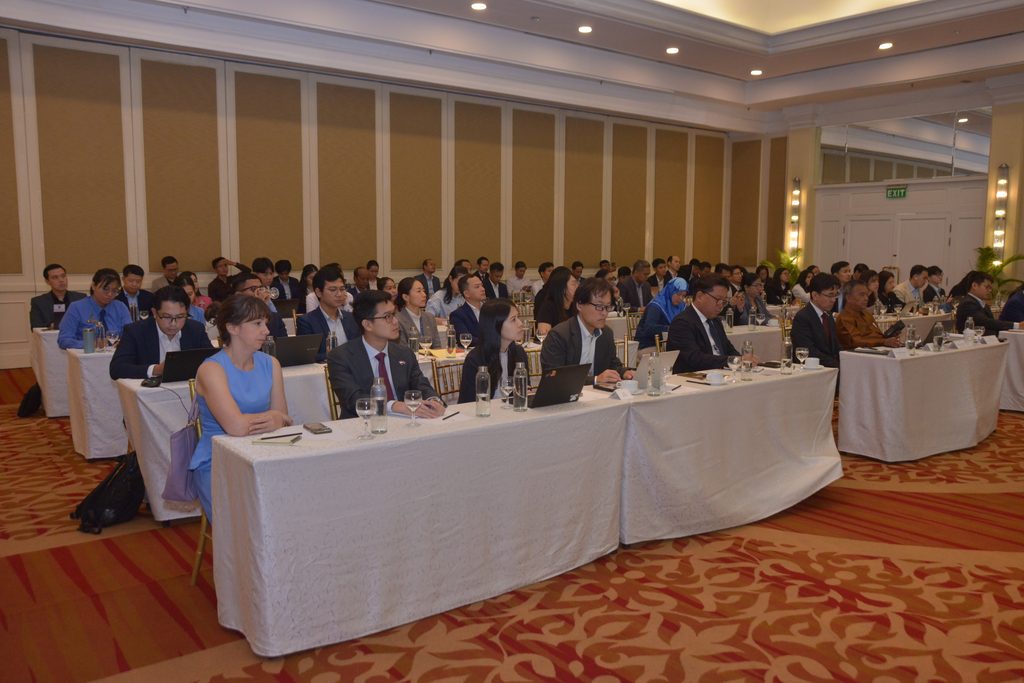
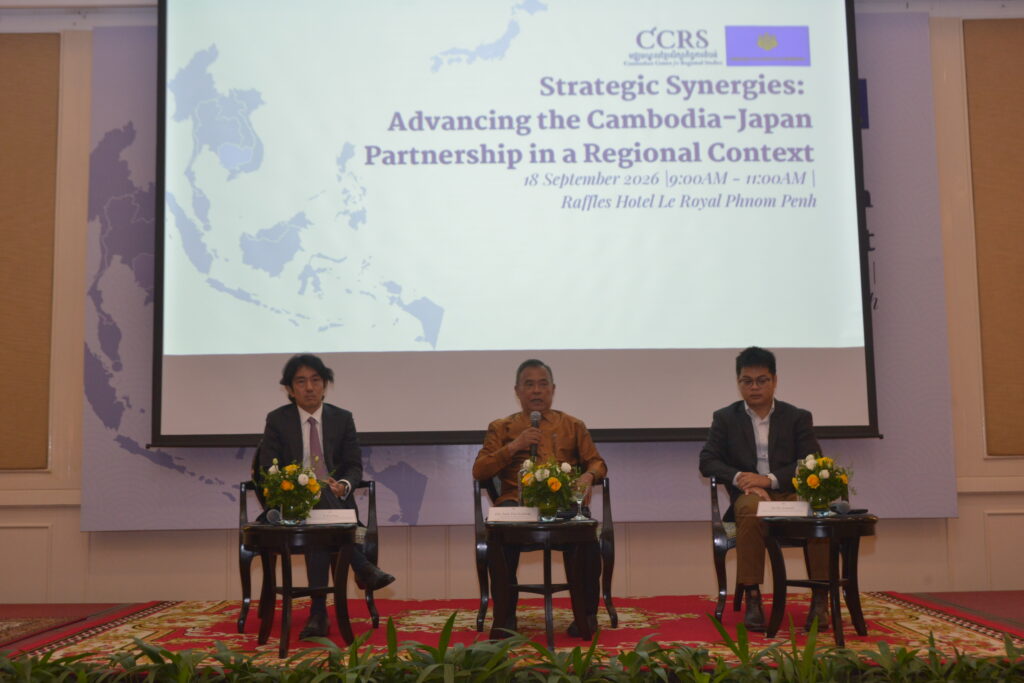
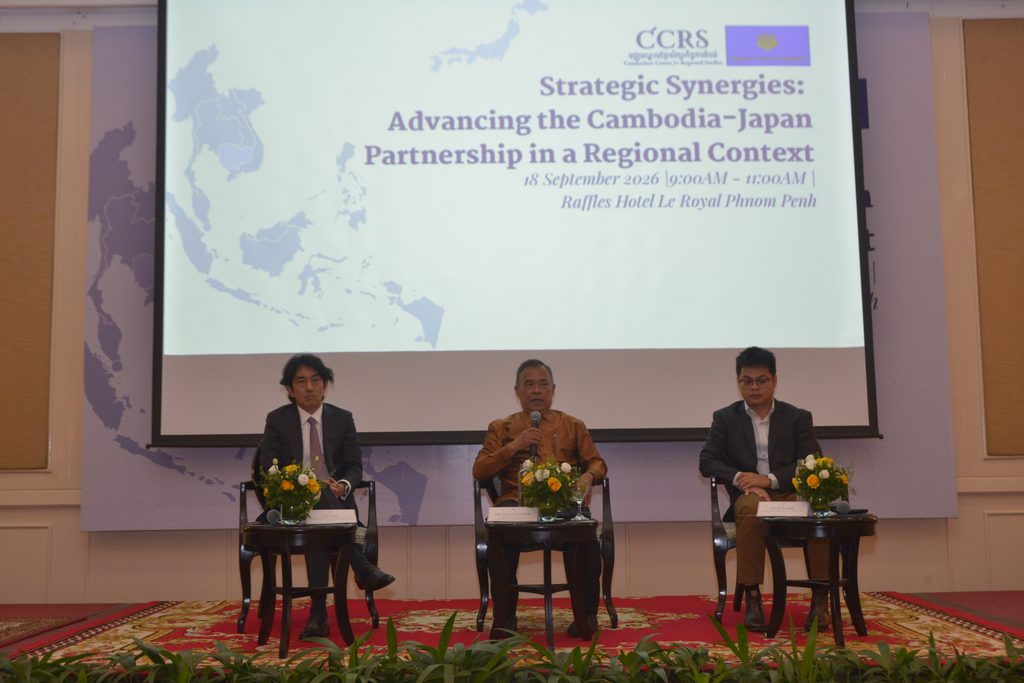
On 18 September 2026, the Cambodian Center for Regional Studies (CCRS), in partnership with the Embassy of Japan in Cambodia, organized a policy dialogue entitled “Strategic Synergies: Advancing the Cambodia–Japan Partnership in a Regional Context” at Raffles Hotel Le Royal. The dialogue featured Professor Kei Koga, Associate Professor and Head of the Public Policy and Global Affairs Program at Nanyang Technological University (NTU), and Dr. Po Sovinda, Researcher at the Institute for International Studies and Public Policy (IISPP), and was moderated by Amb. Pou Sothirak, Distinguished Senior Advisor to CCRS. More than 70 attendees took part in the event, including Cambodian government officials, members of the diplomatic corps, academia, civil society leaders, and university students.
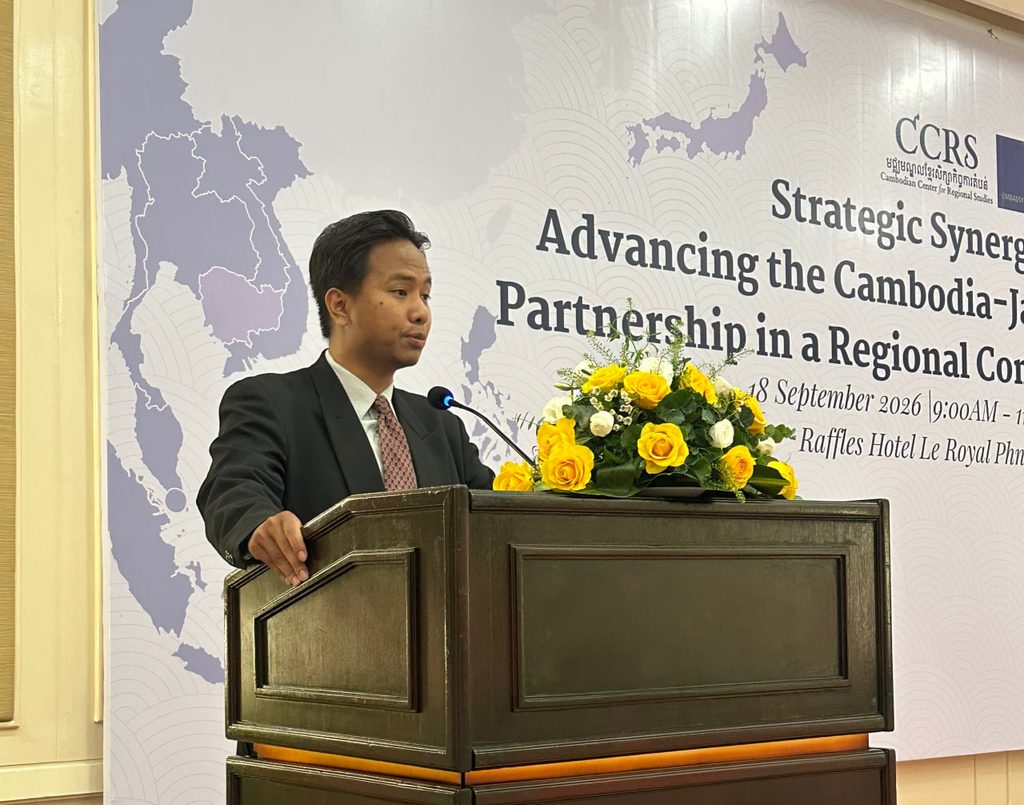
The dialogue aimed to examine the evolving profile of the Cambodia–Japan relationship within the broader regional architecture and to explore how the vision of a Free and Open Indo-Pacific (FOIP) can be translated into practical strategic cooperation amid a rapidly changing and increasingly volatile regional environment.
In his opening address, Mr. Misumi Takahito recalled that FOIP was first articulated by then-Prime Minister Abe Shinzo in Nairobi in August 2016, envisioning the vast maritime space connecting the Pacific and Indian Oceans as central to the future peace and prosperity of the international community. He observed that while the strategic environment has changed considerably over the past decade—marked by growing geopolitical competition, economic and technological uncertainty, and increasingly complex challenges to regional stability—the fundamental principles of FOIP have become more, not less, relevant.
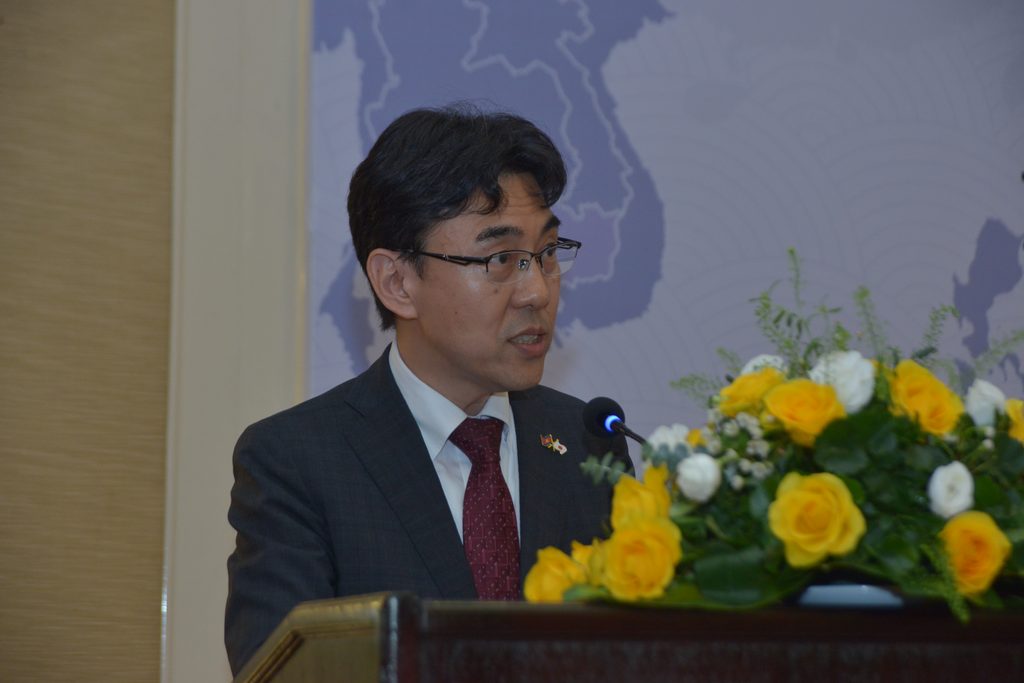
In his opening remarks, Amb. Pou Sothirak acknowledged that Cambodia is presently preoccupied with the complex situation along the Thai border, but argued that the dialogue addresses a set of questions carrying long-term benefits for the country, including a clearer understanding of Japan’s security posture in the region. He cited the 2026 State of Southeast Asia survey recently released by the ISEAS–Yusof Ishak Institute, in which Japan was ranked by regional opinion makers and experts as the most trusted major power in Southeast Asia with a score of 65.6 percent, followed by the European Union (55.9 percent), the United States, China (44 percent), and India (38 percent). He attributed Japan’s sustained position at the top of the ranking to its consistent and non-threatening approach, its heavy commitment to high-quality development infrastructure, and its respect for regional diplomatic frameworks. He further stressed that the merit of Japan security posture for Southeast Asia should be recognized in the following context: (1) Japan provides a transparent, rules-based engagement in a strategically balance way to counter China’s assertive posture in the region; (2) Supporting regional freedom of navigation protects vital trade routes for regional prosperity; (3) provide capacity building, hardware support and upgrade defense capabilities for ASEAN member states; (4) since July, 2026, Tokyo provide Oversee Security Assistance (OSA) to Cambodia with approximately 3 million USD of communication equipment for the Royal Cambodian Army, and patrol boats for the Royal Cambodian Navy; (5) reinforce regional trust and strategic autonomy by strengthening ASEAN Centrality and other ASEAN multilateral frameworks; and promote economic and cyber resilience and help ASEAN maintain strategic autonomy in deterring external threats.
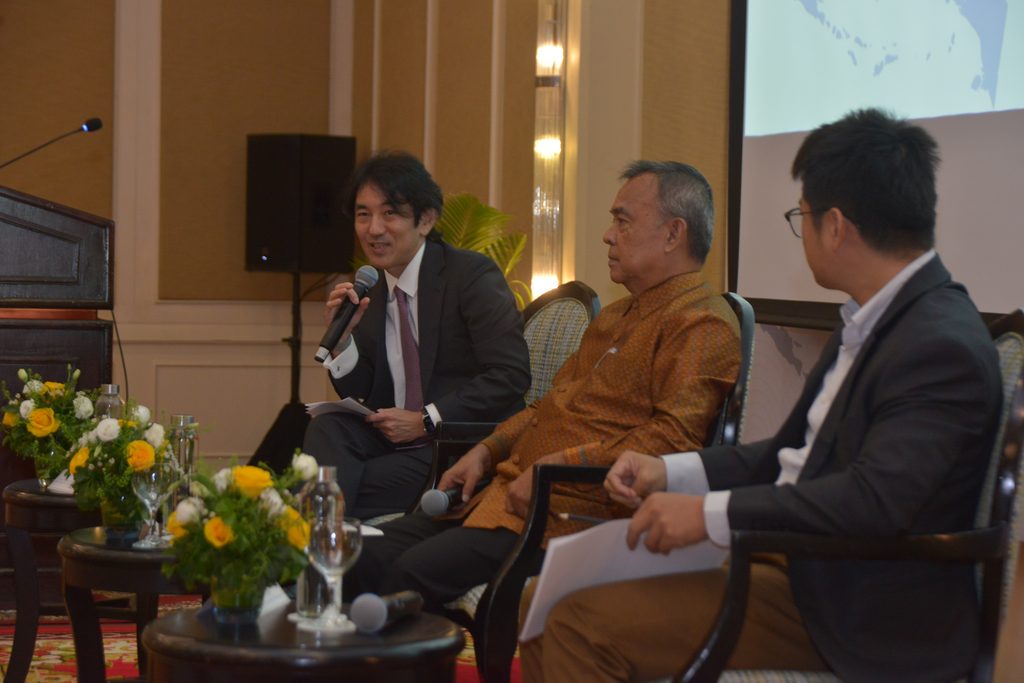
Professor Kei Koga then presented a structured analysis of FOIP’s conceptual foundations, its evolution across three phases. He distinguished FOIP 1.0 (2016–2023) under Prime Minister Shinzo Abe, which focused on strategic scope expansion and conceptualization, aiming to counter or shape China’s behavior through coalition-building in maritime security and infrastructure development, and resting on three pillars—promotion of the rule of law and free trade, economic prosperity through connectivity and trade agreements, and commitment to peace and stability through maritime capacity building and disaster relief. FOIP 2.0 (2023–2026) under Prime Minister Fumio Kishida shifted toward functional cooperation and practical implementation, engaging the “Global South” through value-based rule-making and dialogue across four pillars: principles for peace and prosperity, addressing challenges in an Indo-Pacific way, multi-layered connectivity, and the extension of security cooperation from the maritime domain into the airspace. FOIP 3.0, introduced in 2026 under Prime Minister Sanae Takaichi, centers on resiliency and autonomy, with the core objective of empowering non-great powers by ensuring that partner states possess the capability and freedom to make independent decisions across economic, social, and security domains. Its three pillars are resilient economic infrastructure for the AI and data era, particularly secure supply chains for energy and critical materials; the co-creation of growth opportunities through public–private rule sharing; and enhanced security cooperation for regional stability.
He then drew out some implications for the Japan–Cambodia partnership. Professor Koga argued that operationalizing FOIP 3.0 requires three shifts in the bilateral dynamic. On economic resilience and connectivity, both countries should prioritize risk diversification over economic decoupling. On security cooperation, the emphasis should fall on strategic empowerment rather than bloc creation. On ASEAN and regional governance, Japan and Cambodia should advance a model of co-creation rather than relying on traditional one-way assistance.
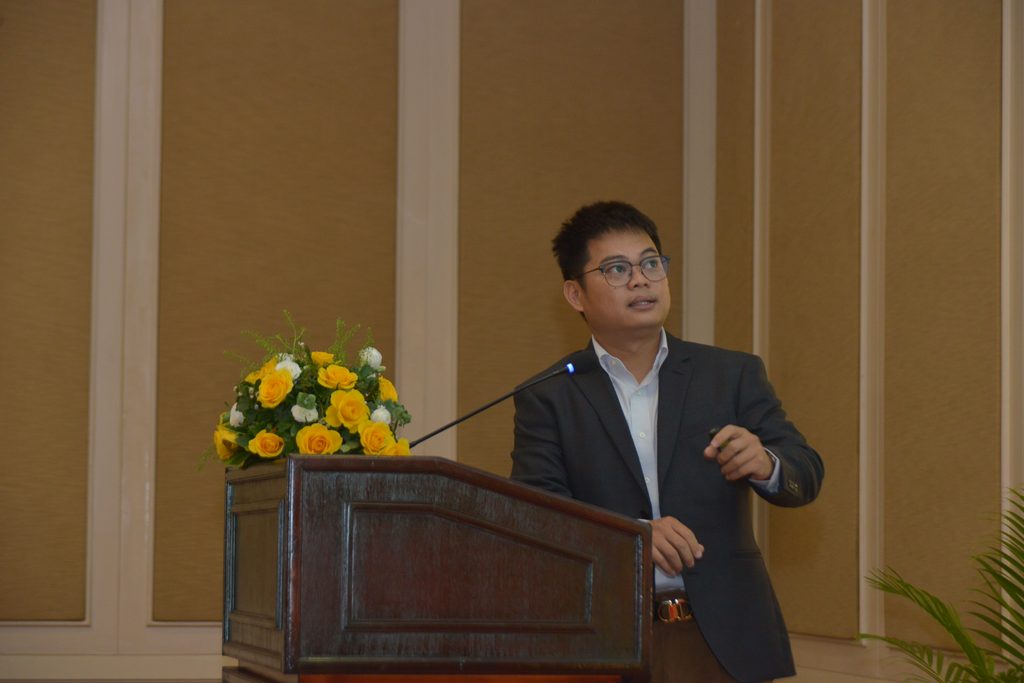
Dr. Po Sovinda followed with an intervention on “Cambodia’s Regional Perspective: Strategic Autonomy, AOIP, and Partnership with Japan,” examining how Cambodia navigates major power dynamics, reinforces its foreign policy balance, and identifies concrete synergies with Japan’s updated FOIP framework. He suggested that practical cooperation with Japan across infrastructure modernization, maritime domain awareness, human resource development, and digital transformation could strengthen Cambodia’s domestic institutional resilience, which in turn allows Cambodia to make sovereign and autonomous strategic choices. Deepening the Cambodia–Japan Comprehensive Strategic Partnership creates actionable avenues for functional cooperation that contribute directly to stability, economic connectivity, and peace across the broader Indo-Pacific.
Six key takeaways from the dialogue:
– FOIP Endures by Adapting. Ten years after its articulation, FOIP has remained relevant not because its content has been fixed, but because it has been revised across three distinct phases in response to a shifting strategic environment.
– From Countering to Empowering. The center of gravity has moved from coalition-building aimed at shaping China’s behavior toward strengthening the resilience and decision-making autonomy of partner states themselves.
– Convergence Rather Than Imposition. FOIP and AOIP share the principles of ASEAN centrality, inclusiveness, openness, and the rules-based order, which allows the two frameworks to be aligned without subordinating regional initiatives to an external design.
– Cambodia’s Early Support as Diplomatic Capital. As the first ASEAN member state to endorse FOIP, Cambodia holds a distinctive position in the partnership that can be converted into concrete cooperation on its own terms.
– Resilience as the Foundation of Strategic Autonomy. Capacity building in infrastructure, maritime domain awareness, human resources, and digital transformation is not merely developmental assistance; it is the material basis on which a small state exercises independent strategic choice.
– Trust as a Strategic Asset. Japan’s standing as the most trusted major power in Southeast Asia rests on consistency, high-quality development cooperation, and respect for regional frameworks—an asset that underwrites the credibility of co-creation over one-way assistance.
The interactive session that followed, moderated by Amb. Pou Sothirak, produced a substantive exchange between the speakers and participants. The organizers hope that all participants found the policy dialogue useful and constructive. CCRS wishes to thank the Embassy of Japan in Cambodia for its partnership, and all participants for actively engaging with this timely event.