
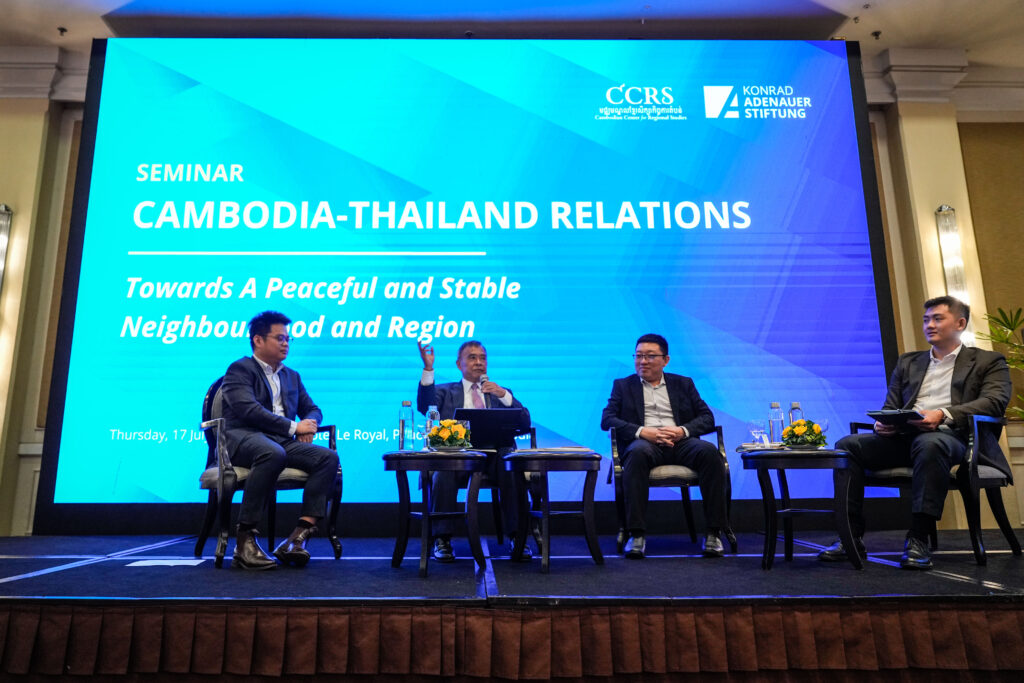
A Seminar on Cambodia-Thailand Relations: Towards Peaceful and Stable Region and Neighborhood was co-organized by the Cambodian Center for Regional Studies (CCRS) and the Konrad Adenauer Stiftung (KAS) on 17 July 2025 at Raffles Hotel in Phnom Penh.
Mr. Him Raksmey, Executive Director of CCRS mentioned that durable and peaceful settlements of border disputes between Cambodia and Thailand depend on the crucial ways forward to promote peaceful ties, good neighborliness, and common interests between the two countries to ensure regional peace and stability. In addition, Ms. Daniela Braun, Acting Country Representative of KAS Cambodia, shared her reflection that even though there have been centuries of exchanges through culture, language, commerce and diplomacy, Cambodia and Thailand must endeavor to overcome the current border crisis by look in to the future of their relations toward creating stability rather than bog down over tensions, cooperation over rivalry, and dialogue over silence. She called on this seminar to focus on finding solutions, depressurized diplomacy to create spaces for reflections and dialogues.
There distinguished scholars were invited to share their viewpoints concerning the outbreak of the border dispute between the two countries.
Dr. Po Sovinda, Independent Research Consultant, highlighted that border conflict between Cambodia and Thailand underscores the complexities of historical grievances and national identity rooted in colonial-era border demarcations. With heightening nationalist sentiments in both nations, the borders have been closed, disrupting trade and straining bilateral relations. The two countries pursue different approach to settle their disputes. While Cambodia appeals to the International Court of Justice (ICJ) for resolution, Thailand’s insists on bilateral negotiations. He made a strong call on ASEAN to help mediate Cambodia and Thailand to peacefully settle the current border tensions as this crisis creates unnecessary implication which affect regional stability and economic cooperation between the two countries.
Mr. Aun Chhengpor, Policy Researcher and Program Manager at Future Forum, stated that the current standoff is quite severe and volatile. While both sides are committed to peaceful dispute settlements, they disagree on paths towards solutions, with Cambodia opting for both bilateral and the International Court of Justice (ICJ) and Thailand insisting on bilateral talks with Cambodia. People and the economies of both sides bear the blunt to this intense dispute. He discussed the different options that both sides have. Taking a strong stance, Cambodia pursues ICJ for the four contentious areas but also refer to bilateral talks to diffuse tensions. Over reacting, Thailand, on the other hand, maintains the closure of its border, reinforce strong military preparedness and looks to the Joint Border Commission (JBC) as the only way to resolve the border conflicts. He has provided more detail and interesting scenarios as far as options that the two countries might undertake and the likelihood of outcomes emanating from those scenarios.
Amb. Pou Sothirak, Distinguished Senior Advisor to CCRS, gave comprehensive reviews of the border disputes between the two Kingdom. Rooted in historical animosity and flamed by nationalism, the current crisis should be understood in three distinct periods.
The first period was between the early 1900s and the International Court of Justice’s (ICJ) ruling on 15 June, 1962 declaring that Cambodia had sovereignty over the Temple of Preah Vihear. During that time Thailand was reluctant to accept the ICJ ruling but agreed to respect the sovereign ownership of Cambodia over the Temple of Preah Vihear.
The second period was between 2008 and 2013 where border dispute flared up around the 4.6 square kilometers surrounding the Preah Vihear Temple. With deep concerned that dispute flared up into bigger conflicts and violence, Cambodia requested interpretation of the Judgment rendered on 15 June 1962 by the ICJ in the case concerning the Temple of Preah Vihear and an urgent request for the indication of provisional measures. On 18 July 2011, the ICJ gave its decision on the indication of provisional measure by ordering both sides to withdraw their troops, refrain from any armed activity, and allow Indonesian observers to have access to a temporary demilitarized zone. On 11 November 2013, ICJ ruled that the judgement of 15 June 1962 decided that Cambodia had sovereignty over the whole of the promontory of Preah Vihear. However, the ICJ did not specify what is the area within the 4.6 square kilometers is belong to Cambodia.
The current border dispute involves: Mum Bei, Prasat Ta Kra Bei, Prasat Ta Moan Thom, and Prasat Ta Moan Toch. Since a brief clash between Cambodian and Thai soldiers resulted in the loss of life of one Cambodian warrant officer. Since then, the disputes spiral into intense disagreements, fumed by nationalism and engulfed with inflammatory rhetoric. What entails from the reaction and counter reactions have been the ongoing aftermaths that continue to unfolds between the two countries resulted in border closure, cutting off economic interaction, straining bilateral relations and putting the two militaries on a state of possible collision that could lead to unwarranted conflicts due to misunderstanding and hyper nationalistic sentiment.
As for the path towards peaceful resolutions, Amb. Pou Sothirak suggested that both countries should jointly declare “Truce” and build “Trust” by agreeing to:
1. Deescalate military pressure away from the border by declaring permanent ceasefire.
2. Remove their troops 5kms from respective borders to avoid misunderstanding.
3. Accept observers from ASEAN to ensure peaceful environment conducive for diplomacy to prevail.
4. Reinstate the existing excellent pre-28 May condition of bilateral relations by reopening all border crossings and restore trust and understanding based on mutual respects.
5. Refrain from ensuing inflammatory rhetoric and focus on peaceful ways to settle the disputes.
To assist the truce and trust building, both countries should seek good office and mediation from third party (ie ASEAN, China, France, Japan, etc) to facilitate talks to try to reconcile differences, identify all other options, including bilateral negotiation and multilateral frameworks such as arbitration by using the ASEAN or UN frameworks or to refer the unresolved differences to the International Court of Justice.
In conclusion, Amb. Pou Sothirak stated that “a lasting resolution to the contentious border issues between Cambodia and Thailand depends on both countries’ sincere political will in building mutual trust and willingness to find the middle ground for their differences through existing bilateral channels or jointly seek adjudication by international court of justice for their uncompromising claims. In so doing, they should endeavor to remove military threats from the border area, engaging in frank and reconciliatory dialogue, avoid extreme nationalistic sentiment, and allowing for regional and international diplomatic efforts to take effect.”
There were productive engagements with many good questions asked by participants and satisfactory answers given by the three distinguished speakers. The co-organizers hope that all participants find the seminar useful and constructive. CCRS and KAS-Cambodia wish to thank all participants for actively engaging with this topical event.


