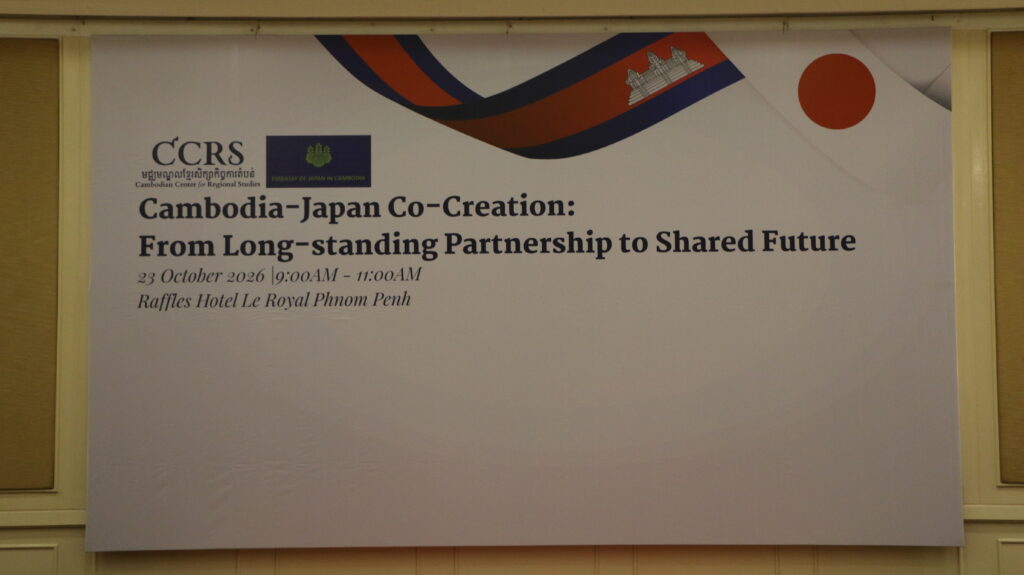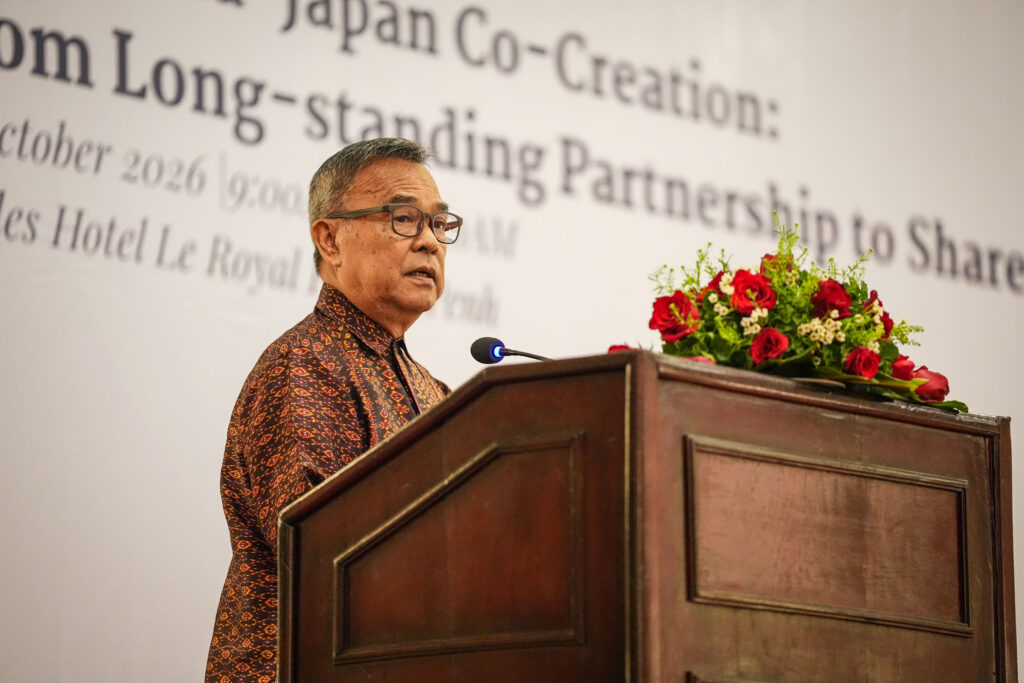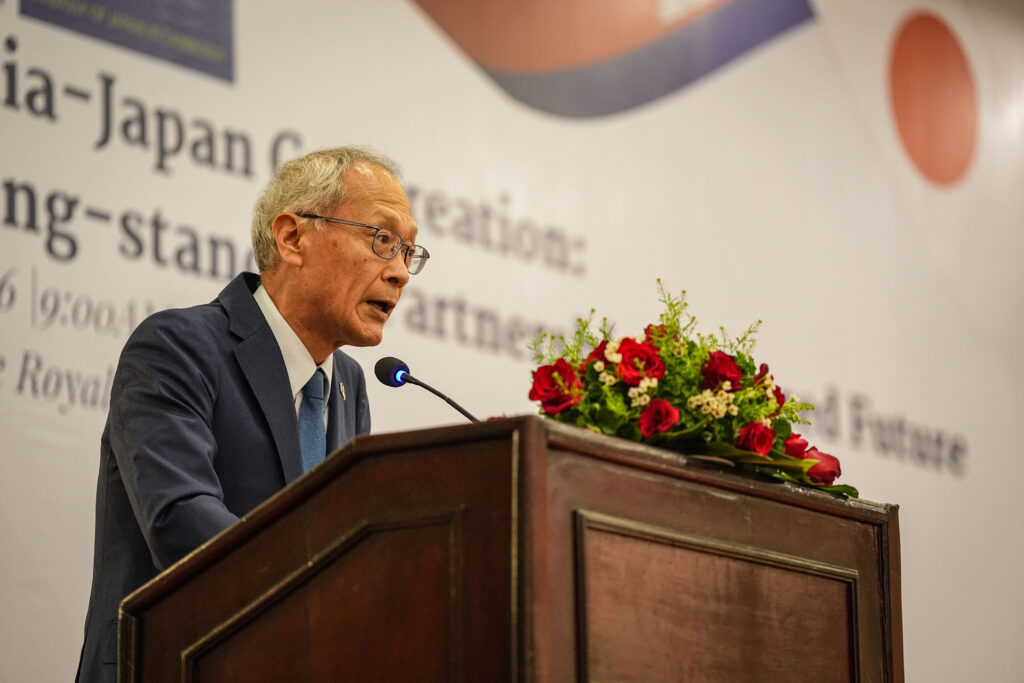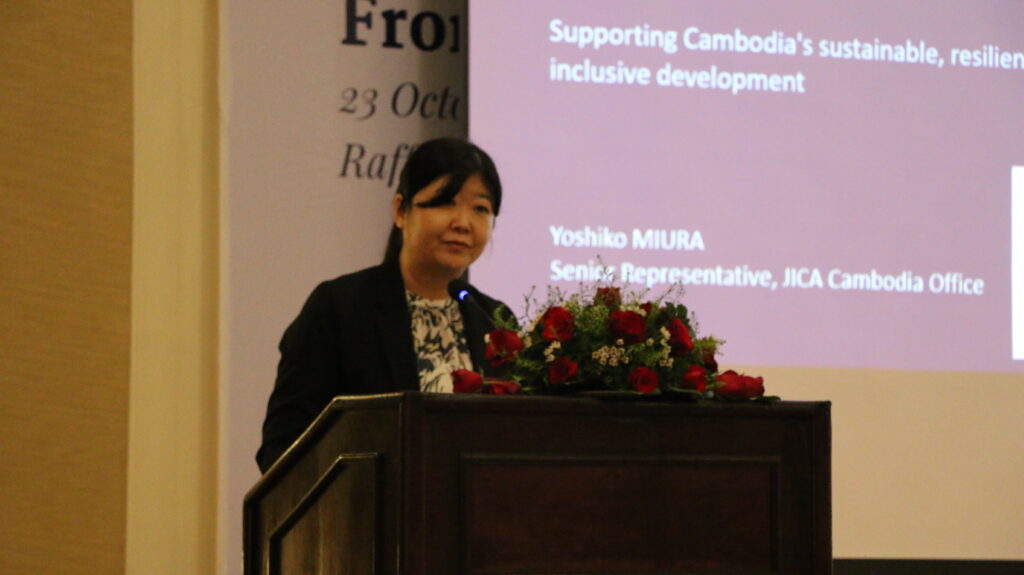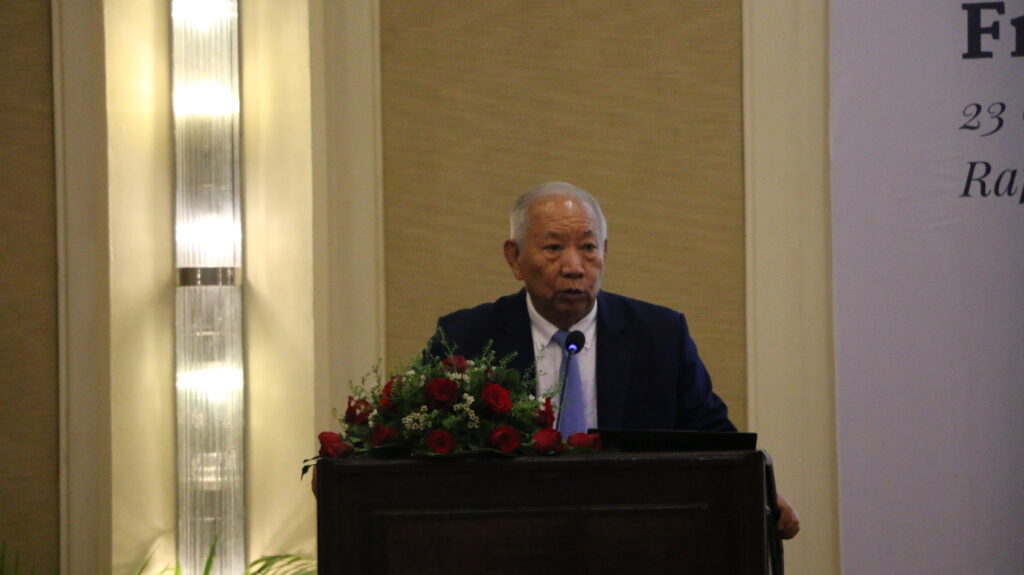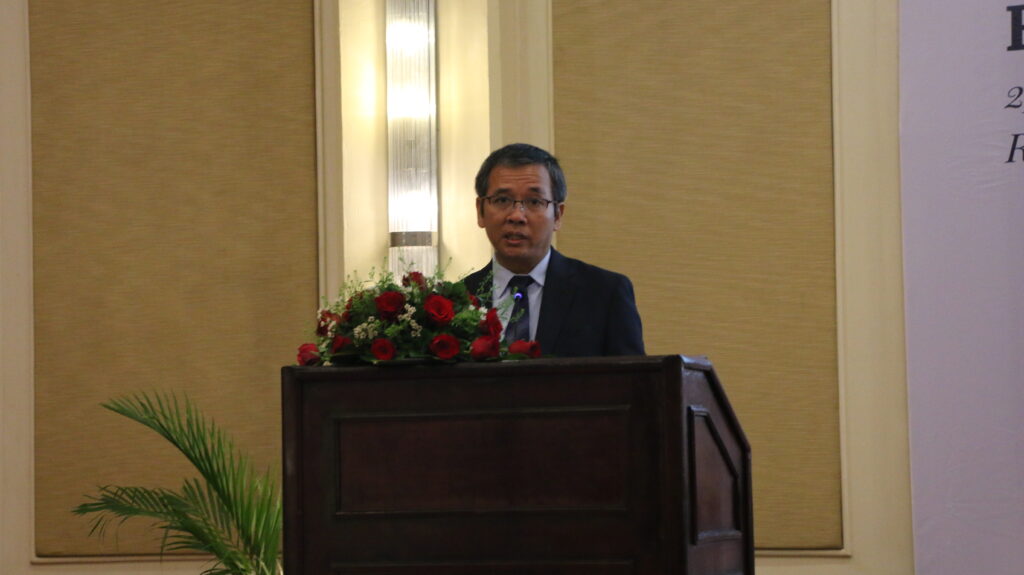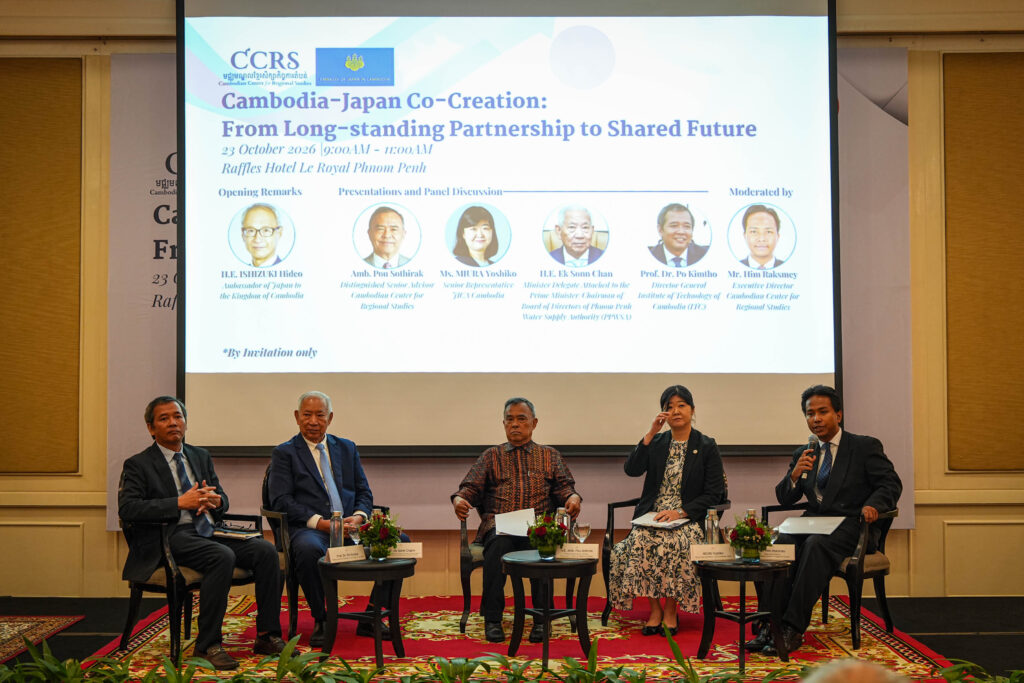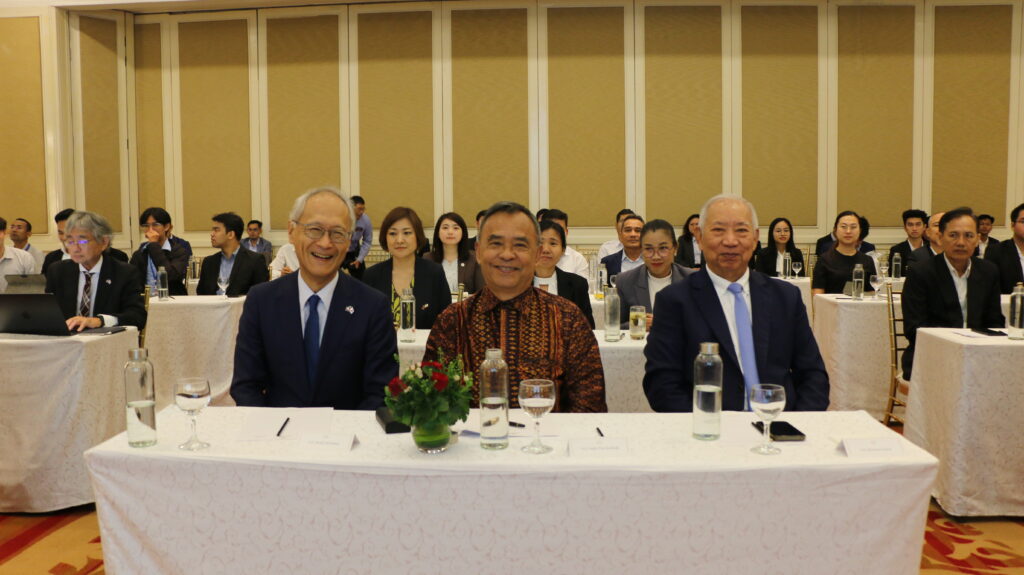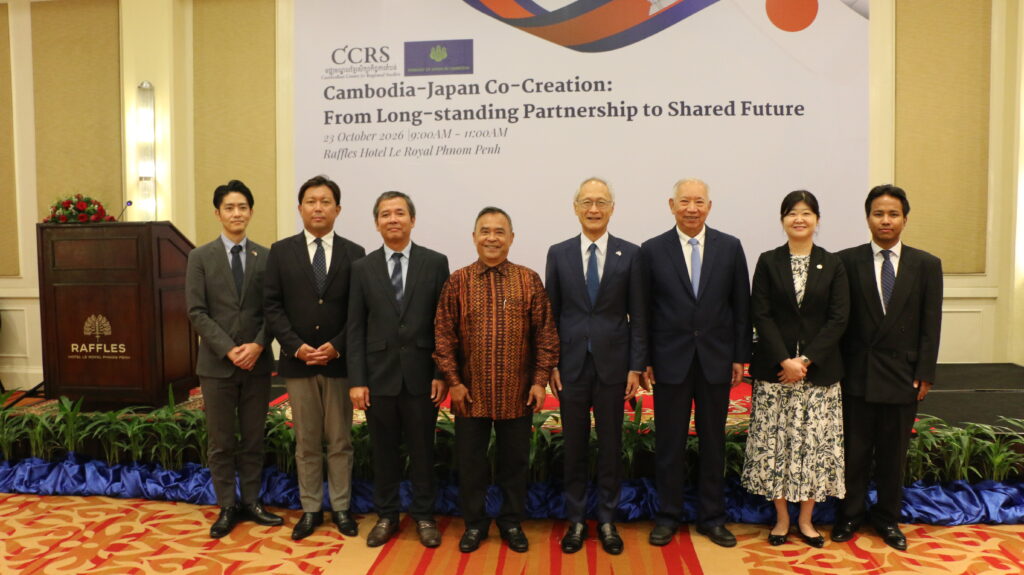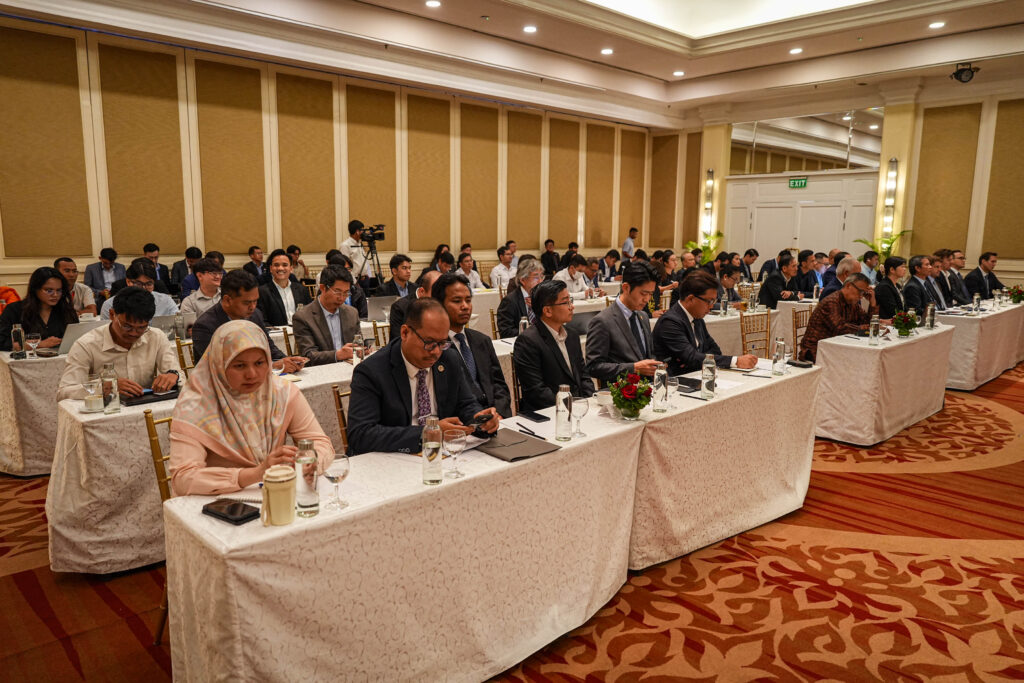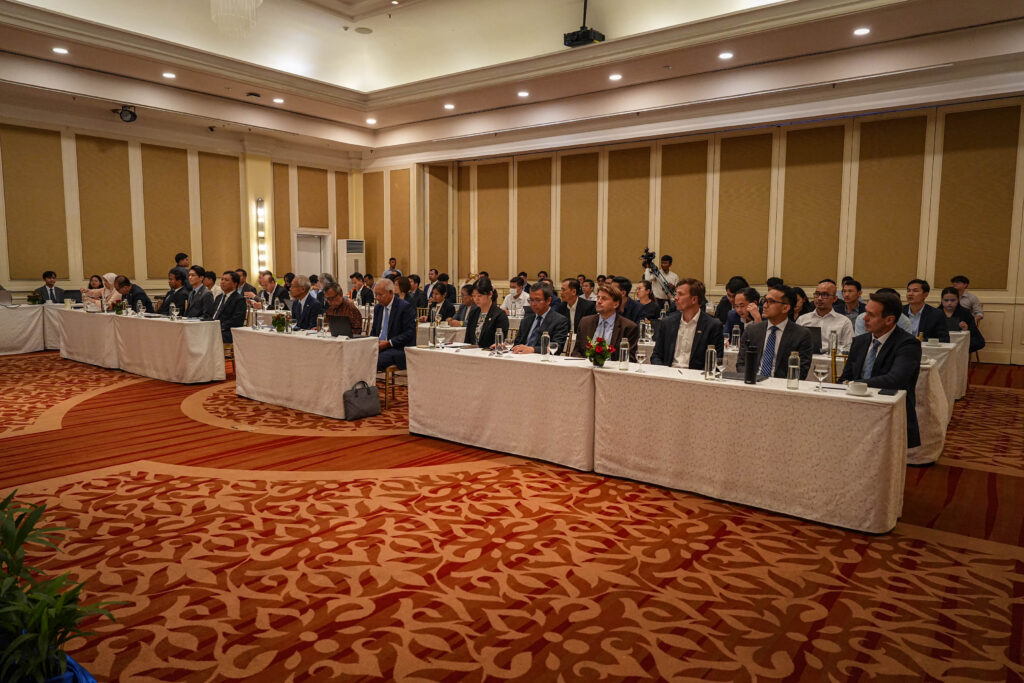
On 23 October 2026, the Cambodian Center for Regional Studies (CCRS), in partnership with the Embassy of Japan in Cambodia, organized a seminar entitled “Cambodia-Japan Co-Creation: From Longstanding Partnership to Shared Future” at Raffles Hotel Le Royal Phnom Penh. The dialogue featured special remarks by H.E. ISHIZUKI Hideo, Ambassador of Japan to Cambodia, and a keynote address by H.E. Amb. Pou Sothirak, Distinguished Senior Advisor to CCRS. Sectoral presentations were delivered by Ms. Miura Yoshiko, Senior Representative at JICA Cambodia; H.E. Ek Sonn Chan, Minister Delegate Attached to the Prime Minister and Chairman of the Phnom Penh Water Supply Authority; and Prof. Dr. Po Kimtho, Director General of the Institute of Technology of Cambodia. The ensuing panel discussion was moderated by Mr. Him Raksmey, Executive Director of CCRS. About 80 attendees took part in this event including Cambodian government officials, members of the diplomatic corps, academia, civil society leaders, and university students.
The dialogue aimed to reflect on the outstanding achievements of Japan-Cambodia cooperation over the past decades and to explore how the two countries can build upon this foundation to create new forms of partnership. Specifically, the seminar examined the transition of bilateral ties from a traditional donor-recipient model toward a Comprehensive Strategic Partnership anchored in the concept of “co-creation”.
In his opening address, Ambassador ISHIZUKI Hideo traced the history of Japan’s full-scale cooperation with Cambodia following the 1991 Paris Peace Agreements, highlighting successful initiatives such as the “Miracle of Phnom Penh” in urban water supply. He observed that as the bilateral relationship was elevated to a Comprehensive Strategic Partnership in 2023, cooperation has expanded beyond traditional aid into economic integration, digital technology, and defense diplomacy, including Japan’s first provision of Official Security Assistance (OSA) to Cambodia and historic naval port calls at Ream Naval Base. Given major changes ranging from technology, supply chains, climate, regional connectivity, and the international environment have taken shape, he emphasized that the next phase of cooperation must be rooted in “co-creation”, aligning with Japan’s updated Free and Open Indo-Pacific (FOIP) vision where both nations identify challenges together and pool their knowledge to generate solutions for the wider region.
In his keynote remarks, Amb. Pou Sothirak acknowledged the deep historical bonds and mutual trust that define Cambodia-Japan relations, noting Japan’s role as a non-intrusive, vital partner in infrastructure, trade, and peacebuilding. He outlined four key pillars of the upgraded Comprehensive Strategic Partnership: economic co-creation, peacebuilding and development, security and maritime cooperation, and regional/multilateral order. Crucially, Amb. Sothirak argued that Japan serves as an essential balancing force for Phnom Penh. By leveraging this partnership, Cambodia can successfully execute its geopolitical hedging strategy, withstand the pressures of intense US-China rivalry, and maintain its strategic autonomy, and strategic choice in selecting Japan as a trusted partner without facing the rigid political conditionalities often imposed by other major powers.
The sectoral presentations provided concrete examples of this evolving partnership. Ms. Miura Yoshiko from JICA emphasized that Japan’s unique approach focuses on building capable people and effective institutions alongside physical infrastructure. She noted that Cambodia is now transitioning into a source of knowledge, exporting its Japanese-supported demining expertise to countries like Ukraine and nations in Africa. H.E. Ek Sonn Chan shared the dramatic transformation of Phnom Penh’s water supply, from 72% water loss in 1993 to a highly profitable, near-million cubic meter daily capacity, while urging future co-creation efforts to address the critical gaps in rural water and floating-community sanitation. Finally, Prof. Dr. Po Kimtho detailed Japan’s foundational role in transforming the Institute of Technology of Cambodia (ITC), stressing that Japan “built people for us.” He highlighted the urgent need for future academic-industry collaborations to prepare Cambodia’s workforce for the AI and digital technology revolution.
The interactive session that followed produced an interesting exchange between the speakers and participants, addressing the state of Cambodia-Japan relations, Japan’s engagement in the region, role of civil society in national development, the realities of rural sanitation, and the mechanisms required to operationalize the new economic co-creation packages.
Six key takeaways from the seminar:
- From Donor-Recipient to Co-Creation: The bilateral relationship has officially matured into a Comprehensive Strategic Partnership. The focus has shifted from one-way developmental assistance toward mutual commercial value, joint problem-solving, and shared strategic goals.
- Strategic Autonomy through Trusted Partnership: In a fragmented geopolitical landscape, Japan acts as a vital balancing force. Partnering with Tokyo allows Cambodia to execute a geopolitical hedging strategy, preventing over-reliance on any single superpower while safeguarding its sovereign decision-making.
- Exporting Cambodian Expertise: The success of the partnership is evidenced by Cambodia’s new ability to project its acquired expertise globally. Collaborative efforts in humanitarian mine action are now being utilized to train personnel from Ukraine and various African nations.
- Importance of international partnership: The complete revitalization of Cambodia’s urban water sector proves that combining international technical assistance with local ownership and leadership yields substantial results.
- Building People, Not Just Infrastructure: Japan’s legacy in Cambodia is heavily rooted in human capital development. Scholarships, joint research, and laboratory-based education have empowered a generation of Cambodian engineers and policymakers to lead their own institutions.
- Frontiers of collaborations: AI, Rural Sanitation, and Civil Society: While urban infrastructure has vastly improved, future co-creation must address emerging challenges. Priorities identified include navigating the AI revolution, addressing severe sanitation deficits in rural and floating communities, and exploring avenues to support and engage with civil society organizations.
CCRS hopes that all participants found the policy dialogue useful and constructive. We wish to thank the Embassy of Japan in Cambodia for its continued partnership, and all participants for actively engaging with this timely event.
Photo Credit: Try Chhaytith, Moeung Cheery/CCRS; Ishikawa/KPT