
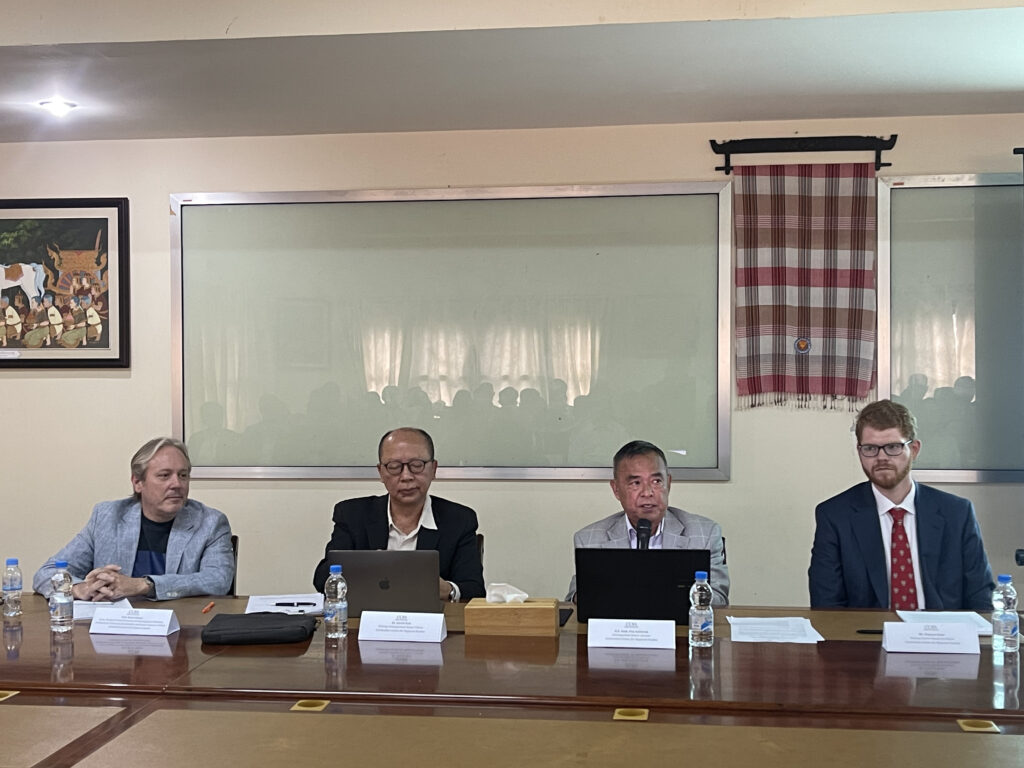
On 1 September 2025, from 9-11am, at Paññāsāstra University of Cambodia’s (PUC) Toul Kork Campus, the Cambodian Center for Regional Studies (CCRS) organized a roundtable on “President Trump’s Foreign Policy Towards Southeast Asia”. About 80 participants took part in this event, ranging from government officials, members of diplomatic corps, academia, civil society, think tankers and young university students. The event was supported by PUC’s Faculty of Social Sciences and International Relations.
The purpose of this roundtable is to discuss how Southeast Asian countries including Cambodia can engage constructively and productively with the US under the administration of President Donald Trump, and vice versa.
Since the end of World War II, the US has dominated the international systems – with hallmark elements such as the rules-based order, economic and trade liberalization, and promotion of human rights. However, today, America’s role in the world is undergoing a profound transformation. There is a growing fatigue with global leadership and the US begins to look inward, affecting how the US engages the world, including Southeast Asia and Cambodia. President Trump’s transactional approach has heightened apprehension among countries in Southeast Asia. Cambodia, for instance, faces steep tariffs from the US due to large trade deficits and the perceived alignment with China. There remain challenges in the US-Cambodia relations including Cambodia’s China policy, human rights and democracy issues, USAID cut, and controversies related to the Ream Naval Base. Nevertheless, there are signs of optimism that Cambodia seeks to reengage the US again in a more productive and strategic ways, amidst the disturbing hotspots affecting regional peace and stability.
Mr. Peyson Hunt, Visiting Senior Fellow at CCRS, shared his perspectives on how the US, under President Trump, sees Southeast Asia in Washington’s grand strategy when engaging ASEAN. At the heart of American strategy is the goal of stopping China from reaching regional hegemony. This priority has pushed nations such as Cambodia, and ASEAN at large, into the center of this battle for influence. Under Trump 2.0 administration, there have been concerns regarding the unpredictable US policy towards the region towards key issues such as tariff and defense engagement. However, the US influence in the region is still considerable as shown in the US roles in brokering a ceasefire agreement to stop the July 2025 fighting between Cambodia and Thailand. Trump’s foreign policy is a reflection of a deeper American mood of feeling tired of global leadership. That makes U.S. engagement less predictable. But it also creates space for Southeast Asia to maneuver. The choices made by Cambodia and ASEAN now will shape not only relations with the United States, but the wider balance of power in the Indo-Pacific for years to come.
Dr. David Koh, Visiting Distinguished Senior Fellow at CCRS, made a presentation on how ASEAN looks at the US under President Trump. The US engagement with Southeast Asia is guided by its Indo-Pacific strategy which is a part of its global strategy to maintain the US prominent place in the international system. There have been concerns including countries in the region regarding Trump’s policy on tariff impositions on friends and foes. Trump’s policy should be understood from a perspective that the US needs to balance its budget and global obligations. In addition, the urgent priority for the US as part of its global strategy that Trump is not saying publicly is to counter China advances from catching up with the US as well as China’s advances in the Southeast Asia. As for how ASEAN countries see the US is closely linked how they perceive the roles of China in their respective interests. The question for countries in the region is not whether US or China are more preferred but how to engage both together. It is up to regional countries to decide how to do so. Regarding the recent US role in broking ceasefire agreement between Cambodia and Thailand as an opportunity to reset Cambodia-US relations, it is important to note that the US is a global power with global, regional and bilateral considerations. How Cambodia can work together with the US on these three-level considerations will be crucial to help enhance Cambodia-US relations. At the end, Dr. David Koh posed thought-provoking questions to the audience: 1/ What are Cambodia’s long-term national interests that can be secured through its relations with the US?; 2/ Has Cambodia settled on a sustainable grand strategy to promote its long-term interests?; 3/ Is there a Cambodia’s long-term grand strategy that perhaps sees a balance between the great powers?; and 4/ if the US is to be a long-term partner to Cambodia, what will both sides bring on the table as the basis for resetting the relations? He urged both Cambodia and the US to look to the future, not the past.
Prof. Kevin Nauen, Dean of the PUC’s Faculty of Social Sciences and International Relations and Senior Fellow at CCRS, deliberated on Cambodia’s strategic calculus towards the US under President Trump. Cambodia foreign policy discourse demonstrates a broadly coherent narrative: Cambodia prioritizes independence, sovereignty, and non-alignment, and emphasizes the ASEAN centrality. Cambodian foreign policy practice demonstrates strategic hedging and an investment in public diplomacy and legal framing as a means to international legitimacy. Cambodian officials emphasize a rules-based respect for sovereignty and the mutual benefits of deep ties with China while offering to work closely with Western partners such as the US. Improved relations with the US will enable Cambodia to take steps towards hedging. The path to improved relations that can be built on the foundation of regime recognition entails both security and economic dimensions. It should be emphasized that to improve its standing with Cambodia and in the region more generally, the U.S. needs to multilateral forums/cooperation, and subtlety, not a sledgehammer. Cambodia and the US can work together on areas such as rotational US ship visits to Ream Naval Base; accepting training and capacity building; offering transparency measures related to Ream; pursuing multilateral project financing; using ASEAN and other forms to frame security cooperation. On economic linkage, the U.S. could support digital trade facilitation which would create more an opening for U.S. service providers. Improved access to U.S. supply chains would also fit well with the current policies of the RGC. Finally, the U.S. could leverage joint investment or loans, in collaboration with U.S. allies that also have strategic and economic interests in Cambodia.
There were interactive discussions during the Q&A sessions. Key questions included: How does ASEAN fit in the US-China competition; Is the ASEAN Centrality enough to withstand pressures to choose sides; What can Cambodia and the US can engage militarily; what are US key roles in helping implement the Cambodia-Thailand ceasefire agreement; has the Cambodia-Thailand border conflict shifted Cambodia’s thinking on security cooperation; what are Japan’s roles in Cambodia beyond economic cooperation; and how has ASEAN worked together with external partners such as the US to bring forth regional public goods for the bloc. The esteemed panelists answered these important questions thoughtfully.
The roundtable was rich in substances, proving useful foods for thoughts on ways the US under President Trump and Southeast Asia including Cambodia can work together to enhance relations.


