
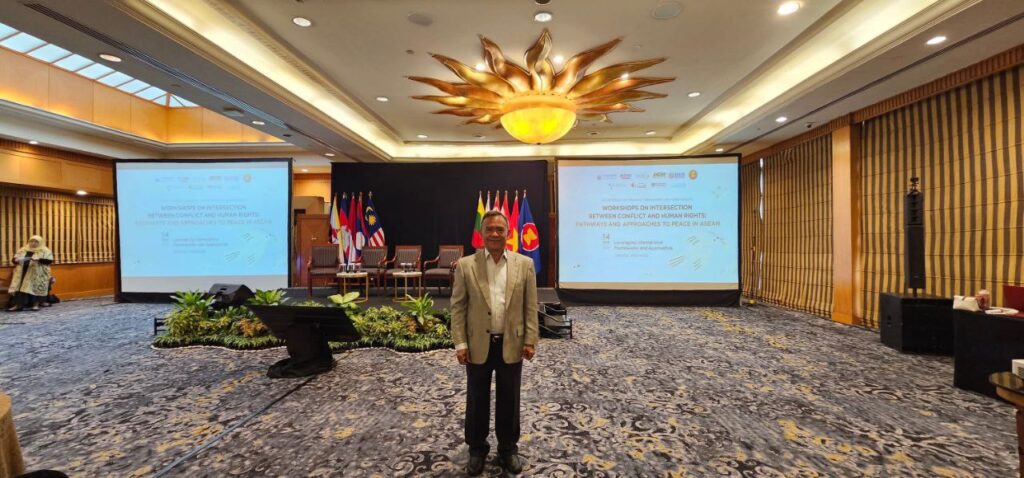
Amb. Pou Sothirak, Distinguished Senior Advisor to CCRS, was invited to speak in a three-day interactive AICHR Training Program on Human Rights in Jakarta from 13-15 August, 2025. During the meeting, he made the following contributions:
The ASEAN human right system have been criticized as responding too slow to the actual human right violation due to strong emphasis on the principles of non-intervention and sovereignty of its members. These principles have prevented them from enacting policies and making statements to protect human rights of members that may be seen as interfering in the domestic problems of another ASEAN member. Unless ASEAN can strengthen its mandate, enhance cooperation with civil society organizations, and ensure that its commitments to human right prevention and protection have actually worked responsively to regional human rights challenges, its credential as the protector of human right remain ineffectual against serious breaches and cannot protect civilians who are getting caught up in zone of conflict. There is also no ASEAN human rights court.
With this understanding, he had a few suggestions as follows:
ASEAN Member States government should work with relevant Think-Tank and Institution to develop home-grown knowledge and understanding of the risk factors relevant to preventing human right abuse through monitoring and development of early warning mechanisms, conduct policy-relevant research, and disseminate information through publications, seminars, and workshops for critical sectors.
National government, including the parliament, should be encouraged to build the capacity of the state in mitigate risk factors and prevent grave abuse of human rights violation, implement relevant existing HR policies swiftly, strengthening institutions, and enacting more laws that are needed for protecting vulnerable populations against these abuses. ASEAN member states should consider develop human right court.
Conducting national risk assessments pertaining to human rights violations by identifying relevant risk factors facing the country and make policy recommendations for appropriate actions to be taken.
Holding regular national dialogues on HR prevention and protection by engaging local multi-stakeholders, including CSOs to promote greater awareness and the need for actionable HR prevention and protection.


