
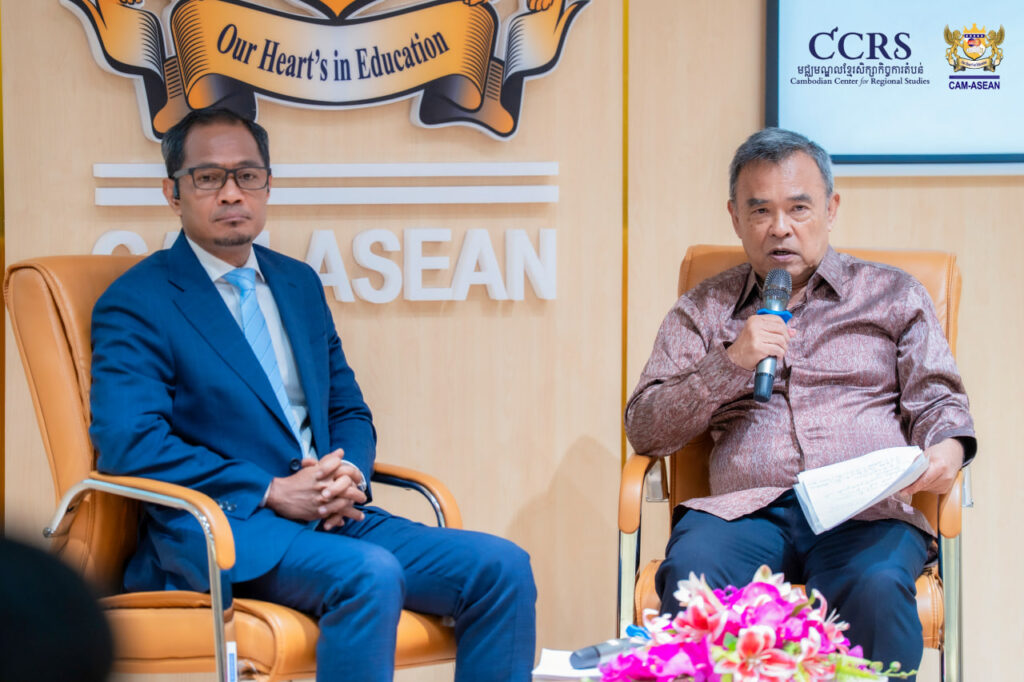
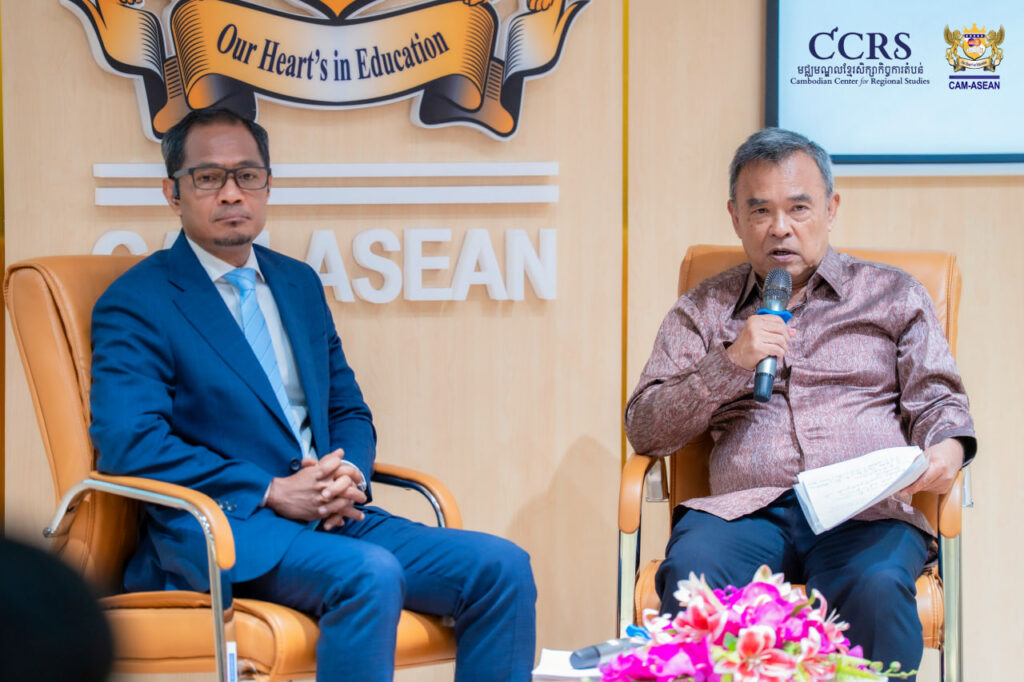
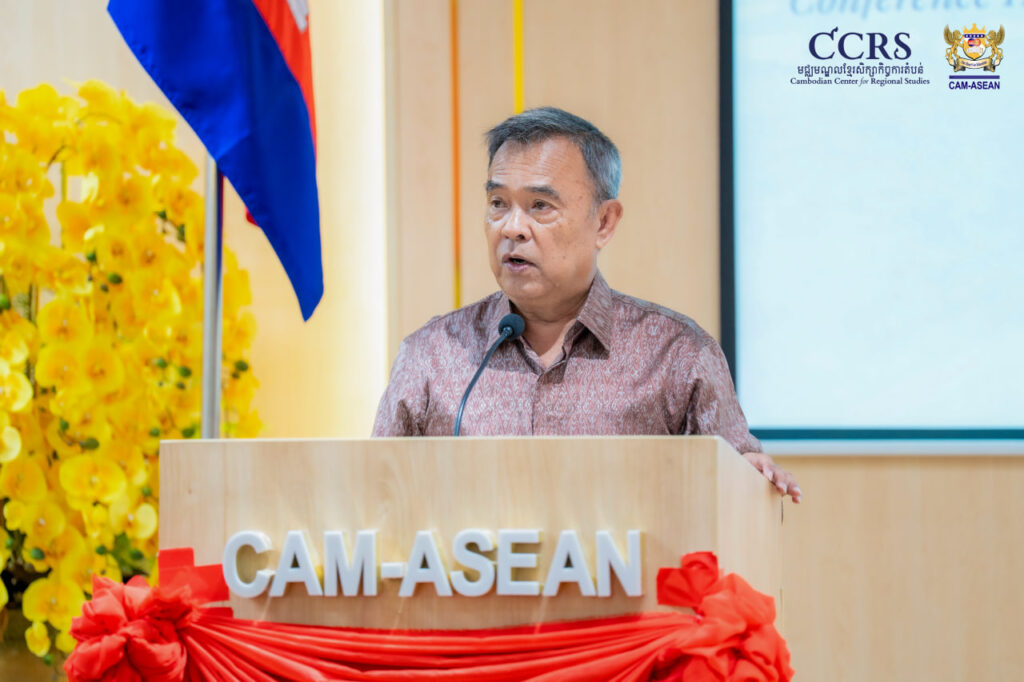
On 3 July 2026, the Cambodian Center for Regional Studies (CCRS) organized an ambassadorial public lecture on “Timor-Leste’s Experiences in the Compulsory Conciliation Process Under UNCLOS” at the CAM-ASEAN Foreign Language School (Tuol Kouk Branch). The lecture featured H.E. Marcos da Costa, Ambassador of Timor-Leste to Cambodia, and was moderated by Amb. Pou Sothirak, Distinguished Senior Advisor to CCRS. Around 100 attendees took part in the event, including Cambodian government officials, members of the diplomatic corps, academia, civil society leaders, and university students.
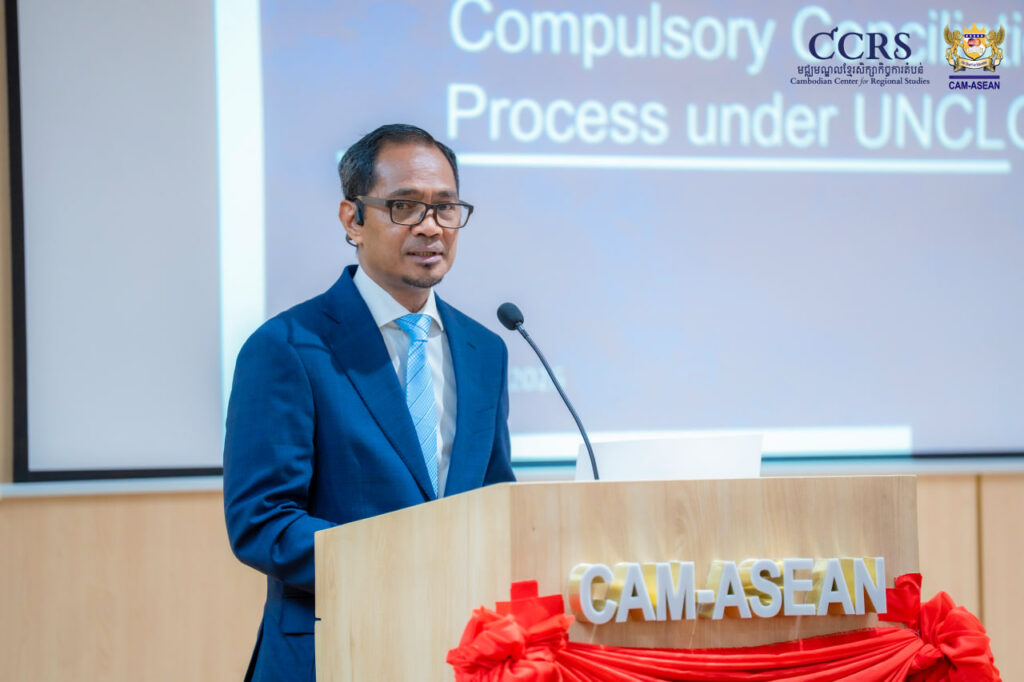
The event aimed to promote a deep understanding of the UNCLOS-mandated compulsory conciliation process as an international mechanism to settle disputes through peaceful means, particularly through the lenses of Timor-Leste’s experiences as a party directly involving in this process. The lecture was highly relevant to Cambodia’s current diplomatic landscape following the cancellation of the MOU2001 between Cambodia and Thailand as well as Cambodia’s subsequent initiation of the compulsory conciliation process under UNCLOS.
Amb. da Costa, drawing on his extensive diplomatic background, provided a comprehensive analysis of Timor-Leste’s historic success in utilizing this exact mechanism with Australia, focusing on three critical domains of the experience.
First, the Historical Rationale and Quest for Sovereignty: Amb. da Costa explained that despite gaining independence, Timor-Leste’s national struggle remained incomplete without recognized maritime boundaries. Because Australia had withdrawn from the binding dispute settlement mechanisms of UNCLOS just two months prior to Timor-Leste’s independence in 2002, traditional legal avenues were blocked. Driven by a fundamental desire to ascertain its sovereign rights under international law, Timor-Leste took a calculated risk in 2016 to invoke compulsory conciliation—an experimental legal tool designed to force dialogue and good-faith negotiation when bilateral pathways are exhausted.
Second, the Mechanics and Strategy of Compulsory Conciliation: The Ambassador detailed how the process functioned not as an adversarial courtroom, but as a confidential framework to build trust and facilitate an amicable settlement. Although Australia initially contested the Commission’s legal competence, the conciliators affirmed their jurisdiction to proceed. Amb. da Costa emphasized that the conciliation succeeded because it actively aligned sovereignty issues with commercial interests by bringing private joint-venture oil companies into the dialogue, while maintaining strict confidentiality regarding sensitive negotiations to prevent public escalation.
Third, the Power of Public Diplomacy and Final Outcomes: Amb. da Costa highlighted the ultimate success of the process: converting a technically non-binding recommendation report into the legally binding 2018 treaty, which established permanent maritime boundaries and a new revenue-sharing split. He noted that a small state can successfully challenge a larger, more powerful neighbor by leveraging international law and soft power. Timor-Leste utilized a unified national voice and activated global solidarity networks for peaceful public advocacy, all while carefully preserving positive people-to-people and state-to-state relations with Australia.
Drawing direct parallels to Cambodia’s current situation with Thailand, Amb. Pou Sothirak noted that compulsory conciliation offers a vital pathway to reopen negotiations when prior bilateral frameworks are destroyed. He concluded that invoking this process is not an aggressive act, but a peaceful, rules-based mechanism that relies on the political courage of both nations to reach a mutually acceptable resolution rather than passing the dispute on to future generations.
Six key takeaways from Amb. Pou:
– Reopening Peaceful Negotiation. Invoking Compulsory Conciliation (CC) is not an attack; it is a legal mechanism to peacefully restart dialogue when prior bilateral agreements (like a canceled MOU) have broken down.
– A Facilitative Process, Not a Court. CC does not declare strict winners or losers. It is a mediation process designed to foster compromise and help both parties reach an amicable settlement.
– From Non-Binding to a Binding Treaty. Through confidence-building, the process can transform non-binding recommendations into a legally binding treaty, provided both sides have the political will to resolve the dispute permanently.
– Clarifying Sovereign Rights. The framework helps clarify a nation’s rightful maritime boundaries under international law, establishing clear parameters for fair resource sharing.
– Equal Rights for Small States. By ratifying UNCLOS, small nations (like Cambodia and Timor-Leste) secure the exact same legal standing as larger powers, empowering them to confidently defend their maritime interests.
– Avoiding Adversarial Rulings. This negotiation-focused process helps states avoid the severe “win/lose” outcomes of international courts (like the ICJ), allowing for equitable sharing rather than risking a total loss for one side.
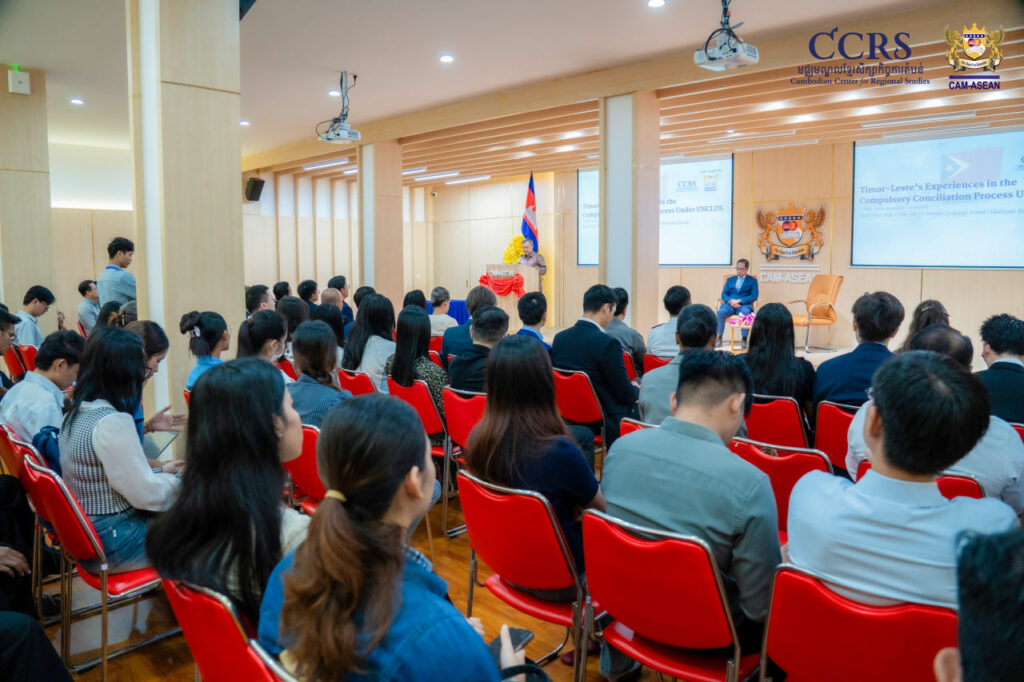
There were productive engagements during the Q&A session, with participants discussing the intricacies of managing public diplomacy, handling third-party border interests like those of Indonesia, and the procedural rules under UNCLOS should a responding state attempt to ignore the process. The organizers hope that all participants found the public lecture useful and constructive. CCRS wishes to thank all participants for actively engaging with this timely event.