

From 19 March to 30 April, Him Rotha, Deputy Director, CCRS visited Russia for InteRussia Fellowship in the field of international relations, a program that is co-organized by the Gorchakov Fund and Institute for International Studies of the Moscow State Institute of International Relations (MGIMO). In this Spring 2025 batch, the fellowship was pursued under the theme of Political Dynamics in the Global South. He was conducting research on the relations between Southeast Asia and the Permanent Members of the United Nations Security Council (UNSC) at MGIMO University during his stay in Moscow. He joined with 9 other batchmates from different countries, namely, Argentina, India, Mexico, Pakistan, South Africa, and Vietnam.

Rotha engaged in different activities, namely from attending lectures by Russian prominent experts to presenting the views of Cambodia and Southeast Asia to academic community in Russia. He learned that Russia, in the period of geopolitical uncertainty, has tried to engage with emerging countries in the Global South or some would term it as Global Majority through various platforms, especially BRICS+. In each forum, he always voiced the importance of upholding multilateralism and international order based on the principle of international law.
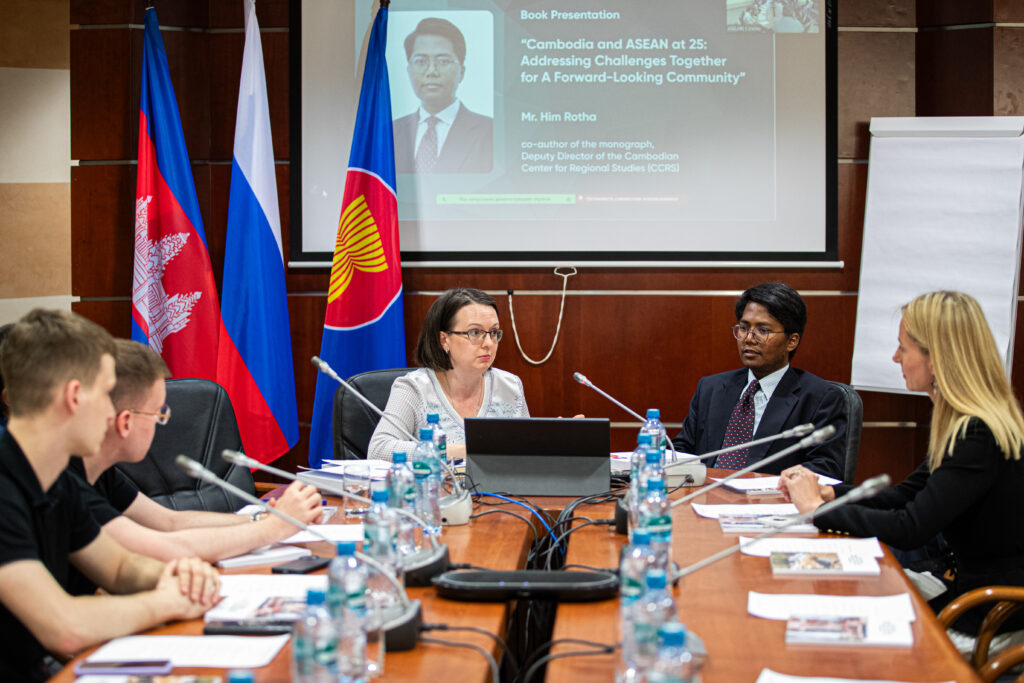
At the sideline of the program, Rotha interacted with ASEAN Centre of MGIMO University to discuss on issues of common concerns and the future potential of collaboration with CCRS. With this occasion, he also did a CCRS Book Presentation on “Cambodia and ASEAN at 25: Addressing Challenges Together towards A Forward-Looking Community” at MGIMO University.

Other than that, he also attended as a speaker to the International Young Scholars Conference on “Development Models: Loading in Progress” organized by the Institute of World Economy and International Relations of the Russian Academy of Social Sciences. He did a presentation on “The Never-Ending Process of Narrowing Development Gap: A Case of Southeast Asia,” of which he tried to share on why some developing countries facing great challenges in catching up with the others.

Overall, the trip was interesting undertaking to learn more about Russia’s views on global and regional trends and how Russia wants to posit itself in Southeast Asia. This also was an opportunity to exchange views on ASEAN-Russia relations and Russia’s presence in this part of the world. This is also a good chance for CCRS as an independent and neutral think thank in Cambodia to connect and link up with the Institute for International Studies and ASEAN Centre of MGIMO University. Rotha brought back to Cambodia deeper understanding of Russia’s role in international affairs and was able to promote the CCRS’ research interests among many Russian scholars whom he met during his 6 weeks visit to Moscow.
